
Shadows in the Show-Me State: Missouri’s Rich Bigfoot History and the Research Groups Tracking It

- Details
- Category: Uncategorised
- Published: Sunday, 19 April 2026 22:34
- Written by Super User
- Hits: 331
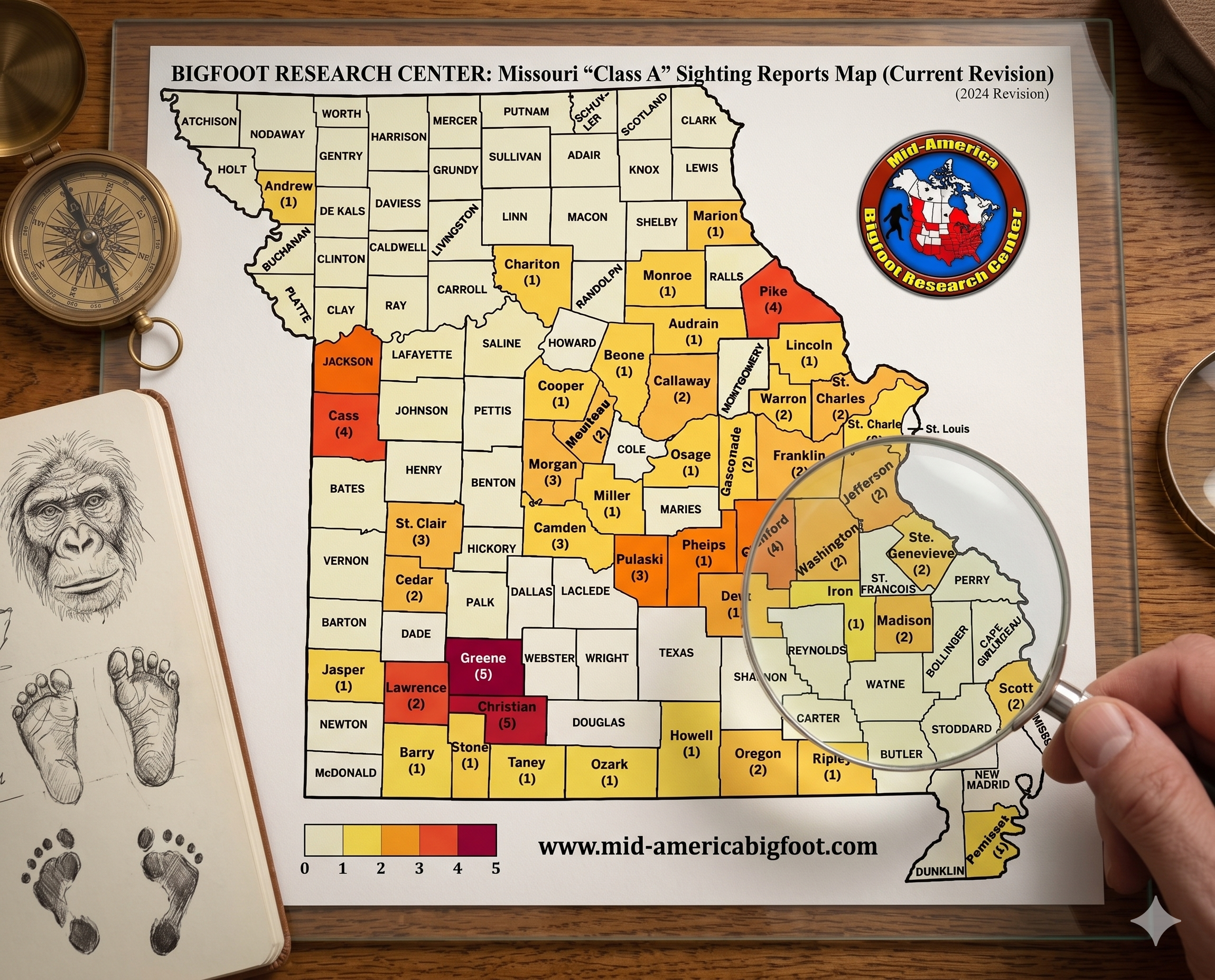
When most people think of Bigfoot, their minds automatically conjure images of the misty, towering pine forests of the Pacific Northwest. Yet, deep in the heart of the Midwest, Missouri has spent over a century quietly building one of the most active and historically significant Bigfoot records in North America. Backed by dense forests, winding river basins, and massive limestone cave systems, the "Show-Me State" is prime territory for a reclusive, unclassified bipedal primate.
Even Leif Erikson and early Norse explorers landing in North America documented encounters with what they called the Skellring—described as a "horribly ugly, hairy, swarthy" biped with massive black eyes. Centuries later, that legacy continues to unfold across Missouri’s deep valleys. Let's explore the historical accounts, modern databases, unique behaviors, and the specific research groups dedicated to tracking this legendary creature.
The Historical Sensation: The Saga of "Momo" (The Missouri Monster)
The modern era of Missouri cryptid research was forever altered in July 1972 by an intense media sensation in the river town of Louisiana, Missouri. The creature, dubbed "Momo" (short for Missouri Monster), made national headlines after a terrifying series of encounters near Marzolf Hill.
On July 11, 1972, Doris Harrison, age fifteen, heard her younger brothers screaming in their backyard. Looking out the window, Doris witnessed a towering, six-to-seven-foot-tall figure covered in thick black hair. The creature had no visible neck and a pumpkin-shaped head with hair so dense it completely obscured its face. Most shockingly, it was carrying what appeared to be a blood-speckled dog under its arm and emitted a putrid, garbage-like odor so intense it made the family dog vomit for hours.
The sighting triggered a massive hunt. A twenty-person posse—including local fire chief and city council member Richard Allan Murray and State Conservation Officer Gus Artus—searched the area. While they didn't catch the beast, investigators discovered handprints pressed deep into hard soil, trampled brush, and tracks over ten inches long. Plaster casts of these tracks, including prints found at the farm of Bill Suddarth, were examined by Lawrence Curtis, the director of the Oklahoma City Zoo, who deemed them to represent an unrecognized primate species.
Decades later, in the spring of 1991, landowner William Magee encountered what his family calls "Mo" on his farm near Bowling Green, Missouri. While riding his four-wheeler along a creek bed, Magee spotted a seven-foot-tall, black-brown haired, hunched creature crouching just thirty feet away. Magee noted its face appeared remarkably human-like. In a split second, the creature displayed explosive athletic power, leaping effortlessly over an eight-foot creek bank to escape.
Modern Databases and Daylight Road-Crossings
Today, sightings have transitioned from newspaper headlines to active digital registries. Organizations have logged over 160 credible reports in Missouri, with encounters heavily concentrated around water systems like Smithville Lake, Lake Wappapello, and the Castor River.
- Clay County (May 2012): Near Smithville Lake, a college student named Cody and three friends parked near a game access area. When the forest fell into an eerie, dead silence, they spotted glowing eyes "like taillights" staring from three-to-four-foot tall grass. As they tried to drive away, an eight-foot-tall, muscular humanoid figure stood straight up right in front of their Jeep.
- Butler County (August 2025): West of Poplar Bluff, landowner Will Boeving received a motion alert from a water-monitoring trail camera on his 700-acre farm. The camera captured a massive, wide-torsoed, dark figure standing mid-creek. When Boeving's six-foot-tall brother stood in the exact same spot for scale, the figure in the image was estimated to be several feet taller and twice as wide.
- Wayne County (2016): A nurse driving home near Lake Wappapello watched a long, wavy-haired, dark figure sprint on all fours across a four-lane highway with unbelievable speed.
|
Location & Date |
Estimated Build |
Hair Color |
Reported Behaviors |
Citations |
|
Louisiana, MO (1972) |
6–7 feet tall, robust |
Black, very dense |
Putrid odor, holding animal carcass |
[cite: 7, 8] |
|
Iron County, MO (2006) |
8 feet tall, Chewbacca-like |
Long brown |
Completely unafraid of humans |
[cite: 14] |
|
Clay County, MO (2012) |
Over 8 feet tall |
Dark |
Taillight-like eye shine, standing near Jeep |
[cite: 4] |
|
Wayne County, MO (2016) |
Long, wavy-haired |
Black/Dark |
Sprinting on all fours across highway |
[cite: 12] |
|
Poplar Bluff, MO (2025) |
Over 8 feet tall, exceptionally wide |
Dark |
Wading mid-creek during daylight |
[cite: 13] |
Anatomical Profile and Unique Behaviors
Missouri Bigfoot reports highlight specific physical traits and behaviors that set these creatures apart:
- Physical Build and Hair Phase
Witnesses describe creatures standing between seven and ten feet tall, with a massive barrel-chested frame, broad shoulders, long arms, and no visible neck. Hair color is predominantly jet black or dark brown, though reddish-brown/auburn phases are regularly reported in river bottoms, and older, solitary specimens are occasionally seen with silver or gray-tinged hair.
- The "Zone of Silence"
A highly consistent behavioral precursor is the abrupt "Oz Effect" or "Silent Zone". Just before an encounter, the entire forest falls dead silent—birds stop singing, crickets cease chirping, and a heavy, unnatural quiet blankets the environment, signaling the presence of an apex predator.
- Locomotion and Defensive Displays
While primarily bipedal, several Missouri reports highlight a terrifying ability to run on all fours (quadrupedal sprinting) to cross roads or clearings quickly. When territory is encroached upon, they utilize acoustic and physical deterrents: loud, rhythmic "wood knocks" (striking branches against trees), high-pitched howling or deep stomach growls, throwing heavy stones, and snapping tree limbs to block paths.
The Organizations on the Trail
The search for Missouri’s elusive hominid has drawn several prominent cryptozoological organizations, each operating under distinct scientific and tactical philosophies:
Bigfoot Field Research Organization (BFRO)
The BFRO is the leading data collection network in North America. In Missouri, the organization has logged over 160 reports. Key figures include Carter Buschardt of Liberty, Missouri, who has investigated over a hundred sightings and consulted on animal television series, and Mary Ann Ziebell, a BFRO investigator and expedition leader. Ziebell, who experienced a stunning Class A sighting on her very first night expedition, organizes the annual Ozark Mountain Bigfoot Conference in Springfield, Missouri.
Gulf Coast Bigfoot Research Organization (GCBRO)
Co-founded by Jim Landsdale and Bobby Hamilton, the GCBRO operates on a proactive, "lethal-harvest" protocol. Believing that mainstream science will never accept Bigfoot's existence without physical proof, they conduct military-style night patrols with high-caliber rifles and thermal optics. They actively log Missouri encounters, including a 2006 camping incident in Iron County where two brothers watched an eight-foot-tall, Chewbacca-like creature with long brown hair stand unfazed near their campsite.
Mid-America Bigfoot Research Center (MABRC)
Directed by veteran researcher D.W. Lee, the MABRC models Bigfoot as an unclassified, highly intelligent great ape—specifically a surviving branch of the prehistoric Gigantopithecus blacki. Lee, who writes the "In the Shadows" column for the Stilwell Democrat-Journal, strictly rejects supernatural theories, focusing instead on troop-tracking dynamics. Lee uses tracking mathematics to verify prints:
Height ≈ 5.8 × Stride Length
MABRC strongly opposes monetary bounties, arguing that encouraging armed, untrained hunters into the woods is highly dangerous to both humans and Sasquatch family groups.
North American Wood-Ape Conservancy (NAWAC)
Led by Michael Mayes (Not sure if he is still in charge), NAWAC approaches the phenomenon with a strict, conservation-oriented biological perspective. Famous for their intensive, multi-month field saturation surveys in a remote valley near the Oklahoma-Arkansas-Missouri borderlands known as "Area X", NAWAC’s goal is to secure official scientific and governmental recognition of the "wood ape" to establish immediate federal habitat protections.
Local Smaller Research Groups
Missouri is also home to grassroots tracking groups and cross-border research collaborations. The Arkansas Primate Evidence Society (APES), co-founded by Robert Swain (pastor, researcher, and artist behind the "Laughsquatch" cartoon), actively shares data on river basin migrations with Missouri investigators. Additionally, the annual Ozark Mountain Bigfoot Conference at the Relics Event Center in Springfield serves as a vital hub for local trackers, bringing in notable speakers like Brian King-Sharp, Jason Kenzie, and Richard Taylor to standardize track casting methods and compile regional data.
Conclusion
Whether you are a steadfast believer, a scientific skeptic, or a casual fan of backwoods mysteries, the sheer volume and geographical consistency of Missouri's Bigfoot reports are hard to ignore. From the historical panic of Momo to modern trail-cam captures in Poplar Bluff, the Show-Me State continues to prove that its deep valleys and quiet hollows hide secrets that science has yet to fully explain.
The next time you are hiking through the Mark Twain National Forest and the woods suddenly fall dead silent—keep your eyes on the treeline. You might just catch a glimpse of Missouri's oldest wild neighbor staring back.