
Home
Into the Sooner State's Shadows: The Rich History and Anatomy of Oklahoma Bigfoot Sightings

- Details
- Category: Uncategorised
- Published: Sunday, 19 April 2026 17:47
- Written by Super User
- Hits: 1448
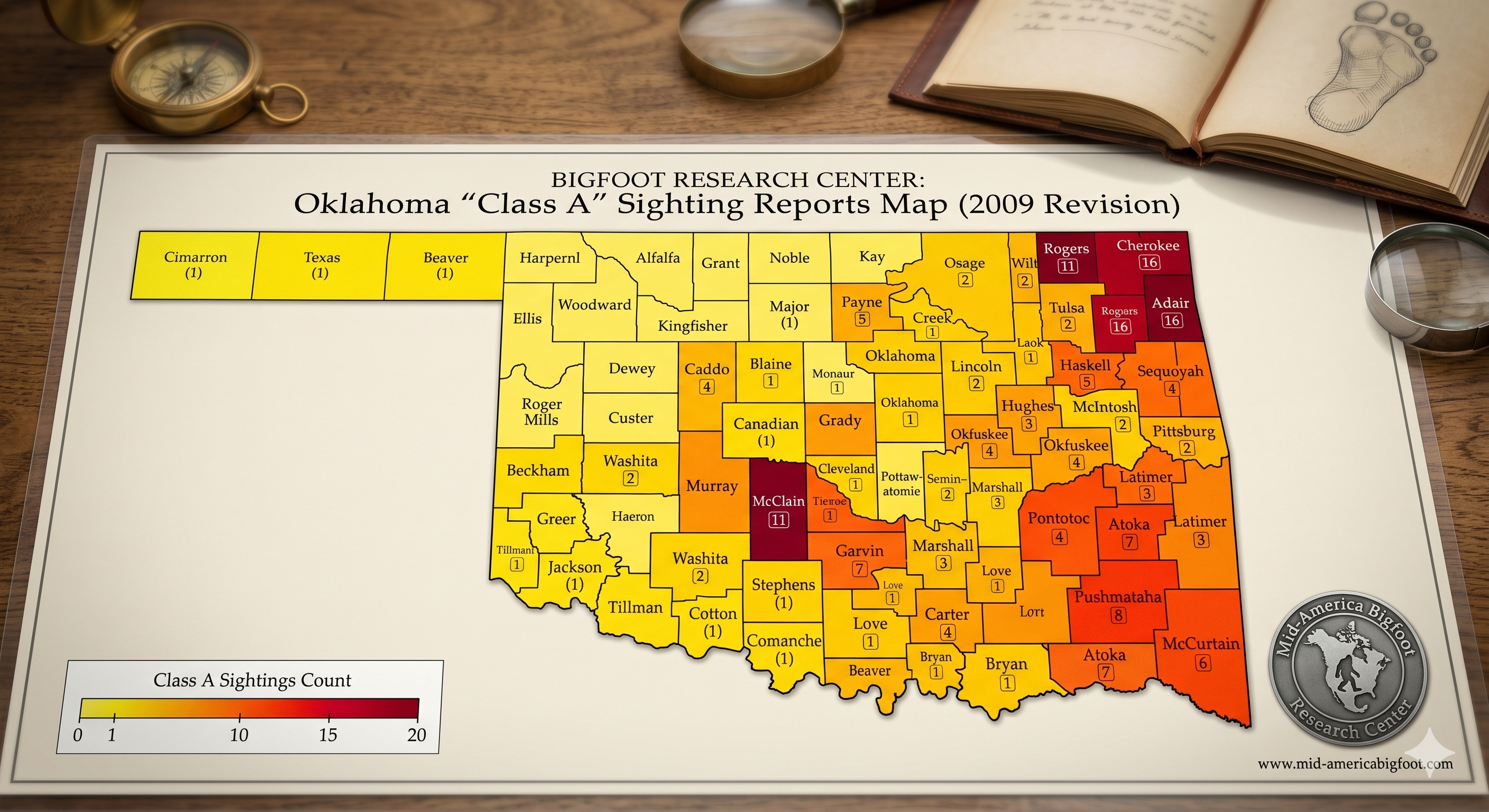
When people think of Bigfoot, their minds typically drift to the dense, misty pine forests of the Pacific Northwest. However, deep in the American Heartland, Oklahoma has quietly built a reputation as one of the premier hotbeds for Sasquatch activity in North America. Boasting over 100 documented reports according to the Bigfoot Field Researchers Organization (BFRO), and many more from the Gulf Coast Bigfoot Research Organization, Mid-America Bigfoot Research Center, North American Wood-Ape Conservancy, and other smaller groups, the state’s rugged eastern terrain—specifically the dense Ozark National Forest and the sweeping Ouachita Mountains—provides the perfect isolated habitat for an elusive giant.
Through historical newspaper reports, active online databases, and paranormal forums, we can piece together a remarkably consistent profile of Oklahoma's most famous cryptid.
Famous Encounters: From Newspaper Archives to Modern Blogs
Oklahoma’s relationship with "wildmen" and wood apes stretches back generations through Native American folklore, where these creatures were traditionally viewed as respected, reclusive guardians of the forest. However, in the mid-to-late 20th century, human expansion into the wilderness brought these entities directly into the public eye.
The 1970s Wave and the "Noxie Monster"
During the mid-1970s, a massive wave of sightings swept across the state. The most famous of these occurred in September 1975 near the small community of Noxie in Nowata County. Dubbed the "Noxie Monster," the creature generated so much local hysteria that newspapers eagerly covered the story, and armed hunting parties set out into the river bottoms. In one frantic incident, a local farmer accidentally shot his own hunting dog in the dark, thinking the monster had returned.
Around this same area, local campers and Boy Scouts reported terrifying nocturnal experiences. In one notable report, a youth awoke to see a towering humanoid silhouette batting at a lantern that had been hung ten feet off the ground. When the campers began whispering, the creature bolted, hurdling a nearby pasture fence in a single, fluid motion before vanishing into the darkness.
The 2000 "Siege of Honobia"
In southeastern Oklahoma's LeFlore County, the small town of Honobia became the epicenter of modern Bigfoot lore following a terrifying series of events in 2000. According to reports logged by the BFRO and explored deeply on paranormal websites, a local family had planted Austrian snow peas, which heavily attracted local deer. Soon, a group of predatory Bigfoots allegedly began harassing the homestead to hunt the deer.
The behavior of these intruders was shockingly bold. Over several nights, they raided the property. The family realized something was deeply wrong when three complete quartered deer vanished from a chest-high freezer in an outdoor utility shed. Soon after, the creature attempted to break into the home itself, scratching at windows and physically tearing off parts of the exterior window frames. During the peak of the "siege," one of the creatures was reportedly shot and killed, but its body was quickly carried off into the brush by other members of its family group before investigators could arrive. Today, the town embraces this history by hosting the annual Honobia Bigfoot Festival.
Recent Encounters: Power Lines and River Bottoms
Sightings continue into the modern day. In early 2026, a family driving near the Washita River in Silo, Oklahoma, reported a compelling sighting to the BFRO. While coming over a hill at dusk, three witnesses spotted a massive figure walking along a power line easement approximately 1,500 feet away. The creature immediately stopped in its tracks when it noticed their vehicle, watching them from across the river before slipping back into the treeline.
Physical Profile: Build and Hair Color
Across hundreds of Oklahoma reports, eyewitness descriptions of the creature's physical appearance remain remarkably uniform:
-
The Build: Witnesses describe a towering, bipedal figure standing anywhere from 6 to over 8 feet tall. The creature possesses an incredibly massive, muscular frame, with estimated weights ranging between 400 and 500+ pounds. Key anatomical features include exceptionally broad shoulders, long arms that hang past the knees, and the apparent lack of a visible neck, giving the head a heavily sloped, ape-like transition directly into the torso.
-
The Hair Color: The overwhelming majority of Oklahoma sightings report the creature being covered in thick, coarse hair. The most common colors described are jet black or extremely dark brown. However, regional variations exist; some older family groups spotted in the deep woods have been described as having auburn or dark reddish fur, and a few rare reports from paranormal sites note massive, silver-haired older giants.
-
The Feet: In muddy river basins, such as McCurtain County, researchers have cast prints that are far larger than any human foot, showcasing distinct primate-like features that don't align with any known local wildlife.
Behavioral Traits and Environmental Clues
Paranormal investigators and cryptozoologists have cataloged several highly specific behaviors associated with Oklahoma Bigfoot sightings:
-
Acoustic Signatures and Wood Knocks: Like Sasquatch reports elsewhere, Oklahoma witnesses frequently report hearing loud, rhythmic "tree-knocking" (the sound of wood striking wood) and heavy, bipedal footsteps echoing through the brush. Vocalizations range from high-pitched whistles to deep, low, chest-vibrating growls.
-
The Silent Zone: A common detail on paranormal forums is the "unnatural silence" that precedes an encounter. Witnesses note that just before a sighting, the forest completely dies down—birds stop singing, crickets fall silent, and the entire atmosphere feels heavy and still.
-
Intimidation Tactics: When humans stumble too close to their territory, these creatures reportedly utilize non-lethal escalation tactics to scare people away. This includes vigorously shaking tree branches, throwing rocks or heavy stones toward campsites, and making aggressive, bluff-charging displays.
-
Family Units and Grief: Fascinatingly, some reports suggest these creatures travel in small, tight-knit family units. There are even rare, localized accounts of burial behaviors, where multiple individuals have been observed carrying away their dead or gathering together to cover a deceased family member with piles of river stones and branches. (The burial part is pure speculation on the parts of some researchers in Oklahoma who are into the woo side of research)
The Skeptic's Corner: Fact or Folklore?
While the sheer volume of stories keeps the legend alive, skeptics and mainstream scientists suggest alternative explanations. The primary candidate for misidentification is the American black bear, which is native to Oklahoma's eastern counties. When injured or foraging, black bears are known to stand and walk upright on two legs, standing up to 7 feet tall—a sight that can easily terrify a hiker in low-light conditions.
Furthermore, historical testing of physical evidence has often yielded mundane results. In 1977, when Bigfoot researchers submitted mysterious hair and skin samples to the FBI, the subsequent laboratory analysis concluded the hair was simply of deer origin.