
Home
An Anthropological and Ecological Analysis of Bigfoot Sightings in Arkansas

- Details
- Category: Uncategorised
- Published: Sunday, 19 April 2026 19:51
- Written by Super User
- Hits: 1469
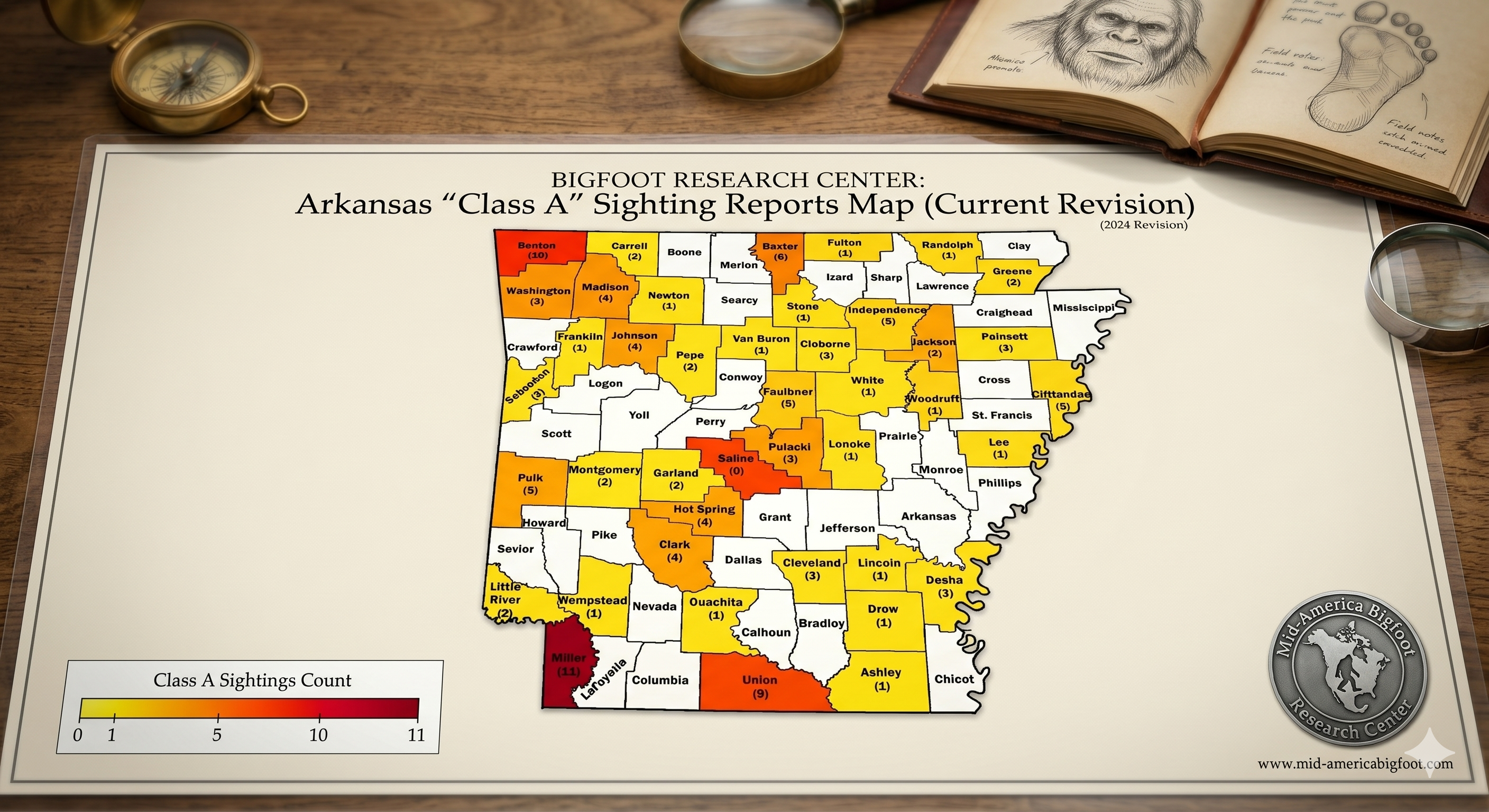
The densely forested wilderness of the Ozark and Ouachita Mountain ranges, combined with the labyrinthine bottomland swamps of the Sulphur and Red River basins, has long positioned the state of Arkansas as a premier focus area for North American hominid cryptogeography. Commonly referred to as Bigfoot, Sasquatch, or the Fouke Monster, these reported bipedal primates represent a complex intersection of historic folklore, amateur investigative science, and local ecological realities. This report provides an exhaustive, multi-disciplinary analysis of historical and modern sightings in Arkansas, utilizing data from archival newspapers, prominent digital databases, and specialized regional research coalitions to outline the morphological, behavioral, and organizational dynamics of this enduring mystery.
Historical Foundations and Newspaper Reporting
The modern era of hominid research in Arkansas was catalyzed by sensationalized encounters in the mid-20th century, though historical precedents extend significantly further. Folklorists and historical geographers trace the origin of the modern "Bigfoot" nomenclature to October 1958, when reporter Andrew Genzoli of the Humboldt Times in California introduced the term after interviewing timber workers regarding massive footprints discovered by tractor operator Jerry Crew. Although plaster casts of these initial tracks were publicized, and later complicated by the 2002 revelation that Crew's coworker, Ray Wallace, had carved wooden feet to hoax tracks, the concept of a reclusive, giant bipedal hominid quickly captured the national imagination.
In Arkansas, reports of a similar creature—historically designated as the "wildman," the "Jonesville Monster," "Ol' Mossyback," or the "Rougaru"—predate the 1958 California media boom, with documented sightings in rural Miller County dating back to 1946. However, the defining event for Arkansas cryptogeography occurred in May 1971 in the small town of Fouke, just outside Texarkana.
A resident named Bobby Ford reported to the local constable that his home had been besieged by a fast-moving, hairy creature standing approximately seven feet tall and measuring three feet across the chest. His wife, Elizabeth Ford, reported observing a hairy, clawed arm reaching through a screen window. Subsequent investigations by the Miller County Sheriff’s Department revealed claw scratches on the home's siding and unusual three-toed footprints in the mud.
The incident was reported by Jim Powell of the Texarkana Gazette and subsequently transmitted nationwide by the Associated Press and United Press International, giving rise to the moniker "Fouke Monster". The media sensation prompted Little Rock radio station KAAY to post a $1,090 bounty on the creature, drawing a massive influx of armed amateur hunters and leading to a temporary firearms ban in the area to ensure public safety.
The cultural footprint of the Fouke sightings was codified in the 1972 docudrama The Legend of Boggy Creek, which showcased the environmental realities of the Sulphur River Bottoms and established a distinct aesthetic for the "Southern Sasquatch" as an aggressive, swamp-dwelling cryptid. Reports of the creature continued throughout the 1970s, including tracks discovered by prospectors in Russellville in 1978 and sightings in Center Ridge. Later incidents, such as a 1991 report of a creature leaping from a bridge and a spate of forty distinct reports in 1997, demonstrate that the phenomenon persisted long after the initial media frenzy subsided.
Morphological and Anatomical Profiles
Eyewitness accounts compiled across Arkansas display a high degree of anatomical and physical consistency. Observers describe a muscular, bipedal primate exhibiting heavy, broad shoulders, long arms, and a distinct lack of a visible neck. Height estimates typically range from six to nine feet, though anomalous reports describe larger specimens standing up to twelve feet tall. Weight is estimated between 250 and 500 pounds for average specimens, with exceptionally large males reported at up to 800 to 1,000 pounds.
Hair Phase and Coloration
Anatomical descriptions suggest a range of hair phases that may correlate with age, gender, or seasonal shedding:
- Jet Black and Dark Brown: The most frequently reported phase in both the Ozark highlands and southern bottomlands, providing optimal camouflage within dense undergrowth.
- Reddish-Brown or Auburn: Notably reported in historic Fouke accounts, including a 1955 sighting by a fourteen-year-old boy who shot at a reddish-furred, ape-like creature with birdshot to no apparent effect.
- Silver or Gray: Typically documented in sightings of exceptionally large, solitary individuals, suggesting an advanced age or unique genetic variance.
Footprint Dynamics and Anomalies
Plaster casts of tracks found in Arkansas generally fall into two categories: standard hominid prints and three-toed anomalies. Standard prints measure up to 17 inches in length and 7 inches in width. However, the three-toed tracks documented in Fouke have puzzled biologists and archaeologists alike.
Archaeologist Frank Schambach of Southern State College calculated a 99 percent probability that these three-toed tracks were man-made hoaxes, as no known living or fossil primates possess three-toed feet. Conversely, some regional researchers, including Jim Landsdale of the Gulf Coast Bigfoot Research Organization, hypothesize that if a reclusive primate population exists within the isolated Sulphur River Basin, extreme genetic bottlenecking and inbreeding could result in localized syndactyly or polydactyly, explaining both the unusual track morphology and the heightened aggression reported in these populations.
Facial Structure and Sensory Organs
The facial structure of the Arkansas hominid is frequently described as a blend of anthropoid and hominin features, characterized by a heavily weathered, tanned skin tone and deep-set eyes. Nighttime encounters often report prominent red or yellow eye-shine.
While skeptics argue that primates lack a tapetum lucidum and attribute reported eye-shine to misidentified nocturnal birds, raccoons, opossums, or standing black bears, witnesses insist the luminosity is internal and distinctive. Hands are consistently described as possessing broad palms with thick, talon-tipped or claw-like fingers, which witnesses have observed manipulating window screens and siding.
|
Morphological Feature |
Common Variant Description |
Anomalous Variant Description |
Associated Region / Case Study |
|
Build and Frame |
6–8 feet tall, 300–500 lbs; barrel-chested, no visible neck, long swinging arms |
10–12 feet tall, 800–1,000 lbs; extremely rapid galloping gait |
Ozarks and Sulphur River Bottoms |
|
Hair / Fur Phase |
Short, dense, matted jet black or dark brown fur |
Long, shaggy reddish-auburn or silver-white hair |
Miller County (reddish-furred juveniles) |
|
Footprint Structure |
14–17 inch five-toed humanoid tracks with deep heel impressions |
Distinctive three-toed tracks (7-inch female and 3-inch juvenile prints) |
Boggy Creek / Scott Keith soybean fields |
|
Facial & Extremities |
Tanned, weathered human-like face; broad hands with thick fingers |
Flat primate face; long, claw-like or talon-tipped nails |
Bobby Ford Homestead (1971 window reach-in) |
Behavioral Typology and Spatial Ecology
The behavioral patterns documented in Arkansas Bigfoot reports suggest a highly developed territorial structure, sophisticated foraging habits, and complex social interactions. These behaviors differentiate the southern populations from the more passive, elusive Sasquatch variants reported in the Pacific Northwest.
Territorial Demarcation and Deterrence
When humans encroach upon active foraging territories, these hominids reportedly employ a series of escalating non-lethal deterrent behaviors. Initial warning signs typically involve tree-knocking (using heavy branches to strike tree trunks, producing a resonant acoustic signal) and deep, gut-vibrating growls. If the intrusion continues, the behavior escalates to rock-throwing, snapping large branches, and aggressive charging displays.
A phenomenon frequently documented on paranormal and cryptid websites is the "Oz Effect," characterized by an abrupt, unnatural silence in the forest. During these episodes, normal wildlife sounds—such as bird vocalizations and insect stridulation—cease completely, creating an eerie atmosphere that witnesses report right before a visual encounter or physical display.
Habituation and Resource Procurement
As commercial timber operations and agricultural expansions reduce contiguous forest cover, hominids are increasingly forced into contact with rural fringes. This habitat fragmentation drives "habituation" behaviors, where individuals or family groups approach human habitations to secure high-calorie food sources.
Documented cases include the theft of large livestock, particularly swine, and raiding outdoor food storage areas. Investigators have documented instances where complete quarters of venison were stolen from chest freezers kept in outdoor sheds, with the intruders damaging doors and window siding to gain access.
Additionally, foraging behavior along creek beds has been recorded; in one notable case along Boggy Creek, investigators discovered a 7-inch footprint alongside a 3-inch print, surrounded by crushed freshwater mussels from which the flesh had been carefully extracted, suggesting a mother teaching foraging techniques to a juvenile.
Social Structure and Mortuary Behaviors
Field researchers hypothesize that these hominids operate in stable family units or "troops". This social structure is supported by reports of sophisticated cooperative behavior, as well as apparent grief and mortuary practices.
In the Pacific Northwest and the Ozark-Ouachita borderlands, witnesses have reported observing multiple hominids cooperatively burying deceased companions under heavy piles of stones or evergreen boughs, displaying behaviors interpreted by onlookers as "sad" or mourning. In the famous "Siege of Honobia" encounter near the Oklahoma-Arkansas border, a hominid that was shot and potentially killed by a homeowner was reportedly carried away by its companions under the cover of darkness, preventing the recovery of a physical specimen.
Extreme Aggression and Physical Confrontations
While most encounters are limited to warning displays, a small subset of historical reports details extreme, sometimes lethal violence. The most dramatic of these accounts occurred in the spring of 1966, when an investigator was dispatched to a remote barn in southern Arkansas to examine the body of an elderly farmer.
The deceased had suffered massive, crushing injuries to the chest, and his limbs had reportedly been disarticulated. A blood-stained pitchfork was found embedded in the ground nearby, suggesting a violent struggle with a massive intruder.
Such physical encounters suggest that while these creatures generally avoid direct conflict, they are capable of defensive violence when cornered or shot at by hunters.
|
Sighting Year |
Approximate Location |
Sighting Source / Platform |
Key Witnesses / Investigators |
Behavioral / Physical Details Reported |
|
1955 |
Boggy Creek / Fouke, AR |
Regional Bigfoot Databases |
Fourteen-year-old local hunter |
Hominid with reddish fur spotted; stood unfazed after being shot with birdshot. |
|
1966 |
Rural Miller County, AR |
Archival Sheriff Reports |
County Coroner / Local Deputy |
Fatal crushing of an elderly farmer in a barn; limbs disarticulated; bloody pitchfork nearby. |
|
1971 |
Ford Homestead / Fouke, AR |
Texarkana Gazette [cite: 4, 11] |
Bobby & Elizabeth Ford |
7-foot creature reached through window; left claw marks and three-toed tracks. |
|
1975 |
Noxie, OK (Border region) |
Regional Press / Scouting Logs |
Local Boy Scout Troop |
Humanoid batting a lantern hung 10 feet high; vaulted a fence in a single fluid motion. |
|
2003 |
North of Mansfield, AR |
Sighting Databases |
Married couple driving from fair |
Black-furred creature, 6+ feet, 400–500 lbs, crouched by roadside; stood and walked away. |
|
2024 |
Buffalo National River / Jasper, AR |
Arkansas Bigfoot Research Center |
Mark Henderson and family |
7–9 foot dark, muscular figure with a human-like face moving swiftly through trees. |
Organizational Taxonomy and Investigative Methodologies
The search for hominid evidence in Arkansas is pursued by several active organizations. These groups range from scientifically oriented conservationists to proactive hunting coalitions, demonstrating the deep divisions within the cryptozoological community.
North American Wood-Ape Conservancy (NAWAC)
The North American Wood-Ape Conservancy (originally founded as the Texas Bigfoot Research Center) approaches the phenomenon from a strict, conservation-oriented biological paradigm. NAWAC rejects paranormal explanations, treating the subject as an undocumented, highly intelligent species of bipedal ape—referred to as the "wood ape"—indigenous to the remote ecoregions of the American South and Southwest.
NAWAC is famous for its intensive, long-term field studies. From 2011 through 2014, the organization conducted the "Ouachita Project," deploying research teams for uninterrupted periods of 60 to 120 days in a highly active, undisclosed wilderness area known as "Area X" near the Arkansas-Oklahoma border.
Using thermal imaging, audio recording arrays, and systematic habitat sweeps, NAWAC documented multiple close-range visual encounters, vocalizations, and structural behaviors. The group's primary objective is to collect the necessary data to establish federal protection for the species and its habitat.
Mid-America Bigfoot Research Center (MABRC)
Operating since 1977, the Mid-America Bigfoot Research Center is led by Executive Director D.W. Lee. MABRC’s research is grounded in the taxonomy of a biological primate, specifically theorizing that the creatures are surviving descendants of Gigantopithecus blacki, a massive Pleistocene ape. D.W. Lee actively opposes the "woo-side" of Bigfoot research, which attributes supernatural or telepathic abilities to the creatures, focusing instead on physical evidence and behavioral patterns.
Lee writes a regular column, "In the Shadows," for the Stilwell Democrat-Journal, detailing tracking dynamics such as stride-to-height ratios:
Height ≈ 5.8 x Stride Length
which is used to evaluate track authenticity. MABRC researchers, including Larry Parks and Jim Whitehead, conduct structured weekend expeditions to track "troops" (estimated at up to two dozen individuals in their primary research zone).
MABRC strongly opposes large financial bounties, arguing that encouraging untrained hunters to enter the woods with high-powered rifles creates an exceptionally dangerous environment.
Gulf Coast Bigfoot Research Organization (GCBRO)
The Gulf Coast Bigfoot Research Organization, co-founded by Jim Landsdale, operates under a controversial, proactive paradigm. GCBRO operates on the premise that the southern Bigfoot is a potentially dangerous, aggressive predator that routinely preys on livestock and poses a threat to rural communities.
Because of this perceived threat, GCBRO's primary goal is to harvest a single adult male specimen for scientific study, believing that physical proof is the only way to force official recognition of the species. GCBRO conducts highly regimented, "military-style" night patrols on private properties throughout Arkansas, Louisiana, and East Texas. Landsdale theorizes that southern hominid family units hunt in predictable geographical loops on a roughly 72-hour cycle, moving between bedding areas and foraging grounds along major river tributaries.
Arkansas Primate Evidence Society (APES)
Co-founded by Robert Swain, a regional pastor, artist, and author of the "Laughsquatch" cartoon series, the Arkansas Primate Evidence Society focuses on historical documentation and community outreach. Swain and the APES organization work to document historical sightings, helping witnesses overcome the social stigma of sharing their encounters.
APES argues that systematic track collection, footprint casting, and public education are the most effective ways to transition the Bigfoot phenomenon from supermarket tabloids to legitimate scientific study.
Local and Grassroots Research Units
In addition to the major regional organizations, several smaller groups focus specifically on localized sighting surges:
- Bigfoot Field Research Organization (BFRO): While national in scope, the BFRO maintains a comprehensive database of categorized Arkansas sightings. The BFRO routinely conducts guided public expeditions in the Ouachita and Ozark regions to compile sighting data.
- Arkansas Bigfoot Research Center (ABRC): Led by local investigator Dennis McCaslin, the ABRC acts as a rapid-response unit for localized surges, such as the recent cluster of over fifty sightings in the Ozark plateau around Jasper and the Buffalo National River.
- Oklahoma Bigfoot Research Organization (OBRO): This group tracks cross-border migrations, documenting how hominids utilize the continuous forests of the Ouachita Mountains to move between Oklahoma and Arkansas.
|
Organization |
Primary Research Focus |
Stated Objective |
Core Paradigm / Stance |
Field Methods |
|
NAWAC [cite: 9] |
Ouachita Mountains / "Area X" |
Federal habitat protection |
Treat as an undocumented, non-human ape species |
Long-term, multi-month wilderness stays and thermal monitoring |
|
MABRC [cite: 22] |
Arkansas-Oklahoma Border |
Primate troop tracking and physical verification |
Relict Gigantopithecus blacki population |
Metric track analysis and thermal imaging |
|
GCBRO [cite: 16] |
Red River and Sabine River Basins |
Establish existence through physical proof |
Potentially dangerous, aggressive predator |
Armed, military-style night patrols |
|
APES [cite: 24] |
Central Arkansas |
Archival preservation and public education |
Legitimate zoological mystery; opposes lethal hunting |
Footprint casting and witness interviews |
|
ABRC [cite: 7] |
Ozark Plateau / Buffalo River Basin |
Sighting documentation and community engagement |
Interactive local wildlife; supports regional tourism |
Rapid response to localized sighting clusters |
Analytical Synthesis of Web and Media Databases
The explosion of digital databases and online forums has significantly altered how hominid sightings are reported, analyzed, and preserved. While these platforms have democratized access to sighting data, they have also introduced challenges regarding data verification and the proliferation of hoaxes.
On paranormal and cryptid websites, reports from Arkansas are often interpreted through a lens of "high strangeness". These accounts describe anomalous phenomena such as temporary memory loss, glowing orbs, and bizarre physical capabilities.
One famous case often discussed on regional forums is the 2002 Lucky Star Casino incident in El Reno, Oklahoma. Security footage reportedly captured an 8-foot-tall humanoid rummaging through a dumpster, but the video was subsequently removed from public domains, sparking widespread debate about potential corporate or government cover-ups.
Similarly, television programs like Travel Channel's Paranormal Caught on Camera have featured dramatic regional cases, such as an episode documenting an Arkansas father and son who claimed to have been actively stalked by a massive creature while camping.
In contrast, mainstream scientific institutions and state agencies remain highly skeptical of these digital databases, pointing to the high likelihood of misidentification and the lack of physical evidence. Wildlife biologists with the University of Arkansas note that many reported encounters are likely misidentifications of the American black bear (Ursus americanus).
This argument is supported by statistical analyses showing that Bigfoot reports are most common in areas with documented black bear populations. When viewed from a distance, in dense foliage, or under poor lighting conditions, a standing black bear can easily appear upright and humanoid to an observer.
[Unidentified Wilderness Encounter]
|
+-----------------------+-----------------------+
| |
[Skeptical / Scientific View] [Cryptozoological View]
| |
- Misidentified American Black Bear • Undocumented Primate Species
- Visual distortion in dense cover • Anthropoid physical characteristics
- High correlation with bear populations • Distinct five-toed or three-toed tracks
- Natural explanations for eyeshine • Consistent behavioral patterns (knocks)
Furthermore, laboratory analyses of physical evidence have consistently failed to support the Bigfoot hypothesis. In 1976, Peter Byrne of the Bigfoot Information Center and Exhibition sent unidentified hair and skin samples to the FBI for analysis.
In a late 1977 response, the FBI concluded that the hairs were of deer family origin. More recently, in 2014, Melba Ketchum of DNA Diagnostics claimed that genetic testing proved Bigfoot was a direct human relative resulting from a cross between modern humans and an unknown primate, proposing the scientific name Homo sapiens cognatus.
However, the study was quickly dismissed by the broader scientific community due to a lack of rigorous peer review and poor data controls, illustrating the persistent gap between mainstream science and amateur cryptozoology.
Socioeconomic Impacts and Cultural Integration
Despite the lack of official scientific recognition, the Bigfoot legend has become deeply woven into the cultural and economic life of several rural Arkansas communities. The town of Fouke serves as a prime example of this transition.
Initially terrified by the 1971 encounters, the community has embraced its status as a premier global cryptid hotspot. The annual Boggy Creek Festival serves as a critical economic driver, attracting cryptozoologists, authors, and tourists from across North America.
Local businesses heavily leverage this identity, offering Bigfoot-themed tours, regional merchandise, and specialty goods. This economic capitalization demonstrates a broader cultural shift: the transformation of a terrifying regional monster into a celebrated figure of local heritage and pride.
Sighting Trends and Habitat Outlook
The spatial distribution of hominid reports in Arkansas reveals a clear connection to the state's major river basins, mountain ranges, and commercial timberlands. As industrial forestry and suburban expansion continue to alter the state's landscape, these reclusive creatures are likely to experience ongoing habitat fragmentation.
While organizations like NAWAC and MABRC continue to deploy advanced technology in hopes of securing definitive proof, the ultimate fate of the Arkansas Bigfoot remains tied to the preservation of the state's remaining deep-wood wilderness. Whether viewed as a biological reality or a persistent cultural myth, the legend of the Southern Sasquatch continues to captivate the public imagination, offering a powerful reminder of the enduring mystery of the natural world.